Tesla has always been at the forefront of integrating cutting-edge automotive technology into its electric vehicles, and its latest AI hardware – Hardware 4 (aka AI4 or HW4) – is no exception. As an advanced suite of Autopilot/self-driving sensors coupled with a new Full Self-Driving (FSD) computer, AI4 pushes the envelope further on autonomous driving, leapfrogging other manufacturers like Ford that produce cars with autopilot-like features.
History: Hardware 3 (AI3) – FSD Computer
Tesla launched its efforts to build the Full Self-Driving (FSD) Computer, also known as Hardware 3 (or HW3) back in early 2016 when they realized there were no other good solutions on the market. Two years later, in late 2018, the FSD Computer went into production – amazingly fast for such a project.
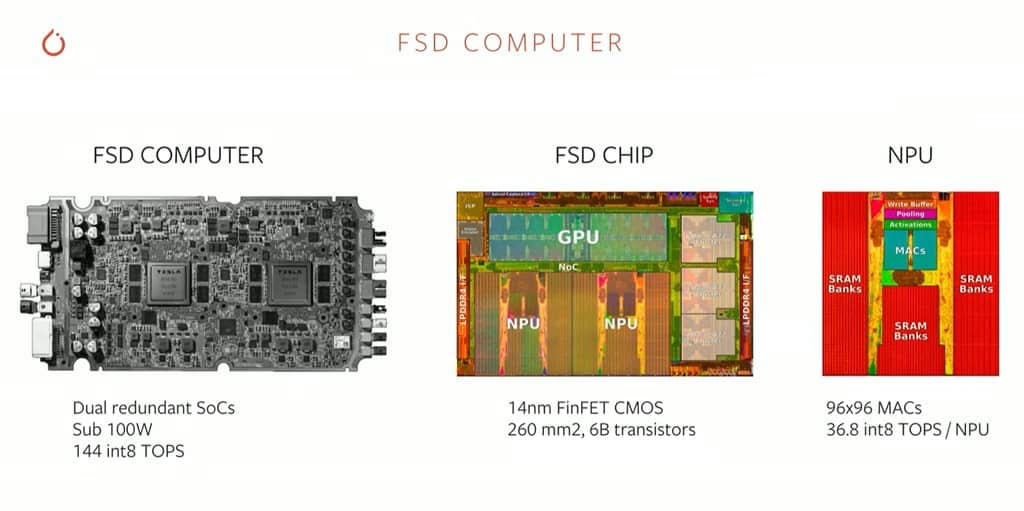
The Tesla FSD Computer is a custom-built Autopilot computer specifically designed to enable Tesla’s electric cars to drive with little human input. The HW3 computer is fabricated on Samsung’s 14 nm process, and it incorporates 3 quad-core Cortex-A72 clusters for a total of 12 CPUs operating at 2.2 GHz. It also features a custom-designed neural network accelerator that can deliver up to 36 TOPS (trillion operations per second) of performance.
The HW3 computer replaced the previous NVIDIA DRIVE PX 2 AI computing platform that was used in Tesla vehicles since late 2016, dubbed Hardware 2.0 (or AP2). The HW3 computer is significantly more powerful than the NVIDIA platform, which could only deliver up to 21 TOPS of performance.
Hardware 3 (AI3) Rollout
Tesla started installing HW3 on all of its cars sometime around April/May 2019. The new hardware-enabled Tesla to improve its FSD features, such as Navigate on Autopilot, Smart Summon, Traffic Light and Stop Sign Control, and FSD Beta. The new hardware also added more visualizations to the display, such as traffic lights, traffic cones, garbage cans and turn arrows painted on the roadway.
Tesla promised that customers who bought a Tesla and paid for the FSD option would be able to upgrade to HW3 for free in the future. However, some customers had to wait for a long time before they could get their upgrade, and some are still waiting as of May 2023. Tesla also reduced the price of the HW3 retrofit from $1,500 to $1,000 in March 2023.
Tesla insisted that it would deliver its promised full self-driving capability to vehicles equipped with HW3. However, some skeptics doubted that HW3 would be enough to achieve true autonomy, especially in complex urban environments. Some also speculated that Tesla was secretly working on a new hardware version that would surpass HW3.
Hardware 4 (AI4) – FSD Computer 2 + New Sensors
While Hardware 3 was all about the computing power of the FSD Computer, Hardware 4 not only includes a significant update to the FSD Computer, but the HW4 specs also include the entire sensor suite.
It’s worth noting that Tesla rolled AI4 / HW4 without making any official announcement. The reason behind this strategy might be to avoid influencing sales of models that hadn’t received the new hardware at the time. The same may occur with future hardware updates.
Updated Sensor Suite
Hardware 4.0 (AI4) is Tesla’s latest suite of Autopilot/self-driving sensors and a new FSD computer. The new hardware, includes the following:
- A new front-facing camera with higher resolution and wider field of view (on some models, such as the Cybertruck).
- A new camera on each B-pillar that can see sideways and slightly forward.
- A new camera on each C-pillar that can see sideways and slightly backward.
- A new rear-facing camera with higher resolution and wider field of view.
- A new cabin camera with higher resolution and wider field of view.
- A new camera on each fender that can see behind the vehicle (tbd, rumored)
- Two new cameras on each side of the vehicle that are mounted lower and more forward than before (tbd, rumored)
- An expected new radar called “Phoenix” that is more accurate than previous units (TBD).
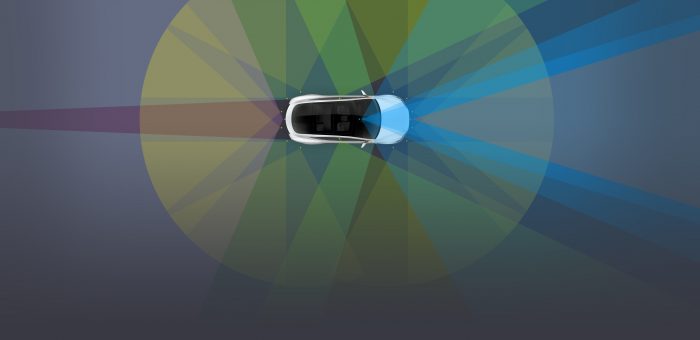
The new hardware can add up to 12 cameras in total, compared to 9 cameras in HW3. One of the camera connectors on the board is labeled “spare”, which suggests that Tesla might add another camera in the future. HOWEVER, we have not yet seen the additional cameras nor the radar unit as of yet.
New Cameras
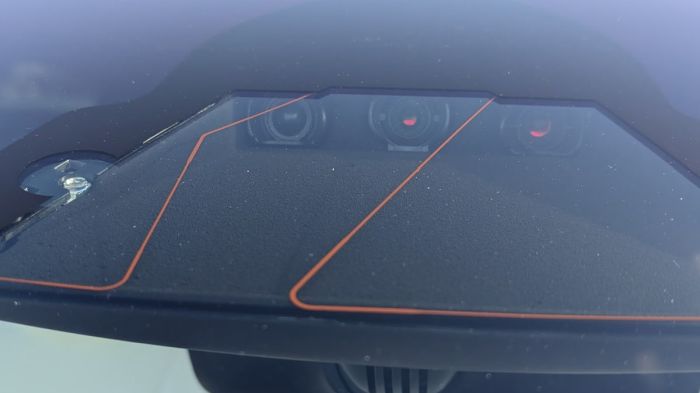
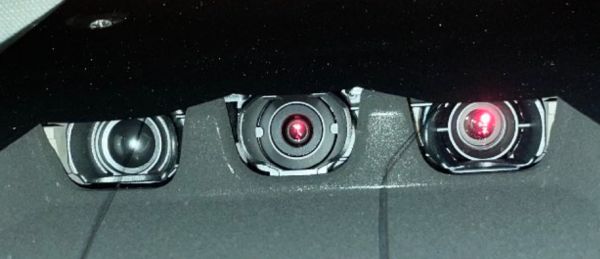
The upgraded cameras, identifiable by their distinct red tint, provide a comprehensive view of the vehicle’s surroundings. Moreover, a heating element has been introduced for the front-facing windscreen cameras to ensure optimal operation under various weather conditions.
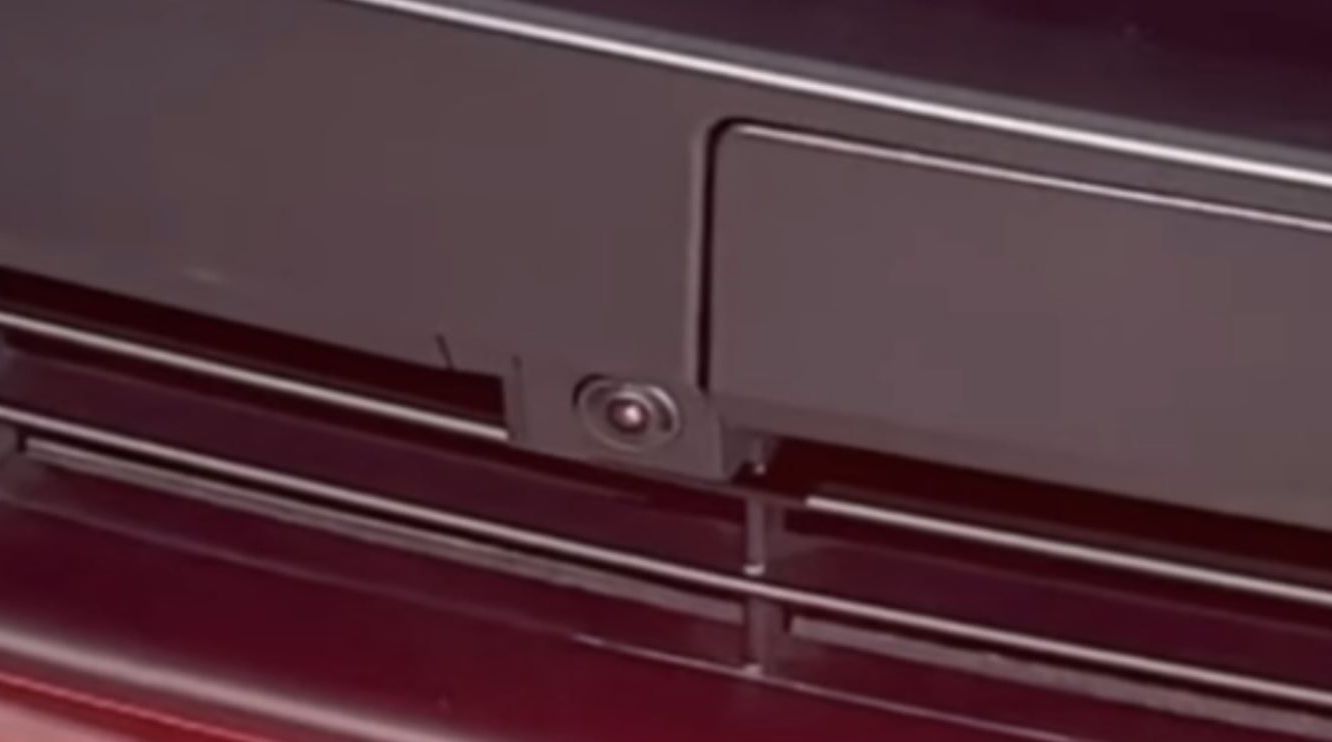
There is also a front bumper camera on the Tesla CyberTruck and there are rumors that this camera may come to other vehicles as well. In fact, some people spotted images on Tesla’s website showing the new Highland Model 3 front bumper camera which were subsequently removed.
The new cameras also make a big difference in the ability for FSD to process real-world information, according to Ashok Elluswamy, who leads Autopilot at Tesla:
New Phoenix Radar Unit
Previously, Elon Musk has stated that having radar sensors in its vehicles is not necessary and that Autopilot and Full Self Driving can operate on camera vision alone – called Tesla Vision.
However, it’s rumored that Hardware 4 also reintroduces radar to Tesla’s sensor suite. After Tesla’s shift to a vision-only system in 2021, the new hardware includes a high-definition radar named Phoenix, likely using the 72 GHz Arbe Phoenix SAR (synthetic aperture radar) radar unit. This HD SAR radar will enhance the accuracy of Tesla’s situational awareness than with vision alone, adding another layer of precision to the self-driving capabilities of the vehicles. For example, this radar unit could potentially see better at night and in foggy, rainy, or snowy environments.
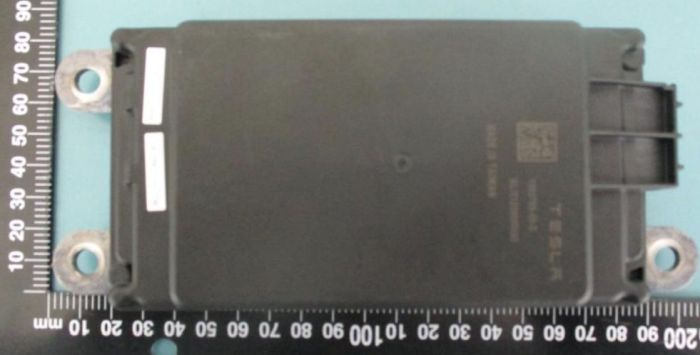
So far, it seems like only Model S and Model X vehicles are shipping with the new radar unit as mentioned in this tweet:
Paging all hw4 radar deniers, I guess.
— green (@greentheonly) June 13, 2023
What is the first thing you do when you get a HW4 car? You take it apart of course pic.twitter.com/THr7f3uKs8
Updated FSD Computer – FSD Computer 2
The new Full Self Driving Computer, dubbed FSD Computer 2, is expected to be about 2-4x faster than Hardware 3, providing a notable increase in processing power. It’s also based on the same Samsung Exynos architecture as before, but this iteration it’s a bit more powerful, with the CPU core count going from 12 to 20 per side, each with a maximum frequency of 2.35 GHz and an idle speed of 1.37 GHz. The neural network accelerator is also improved, delivering up to 50 TOPS of performance compared to 36 TOPS in HW3.
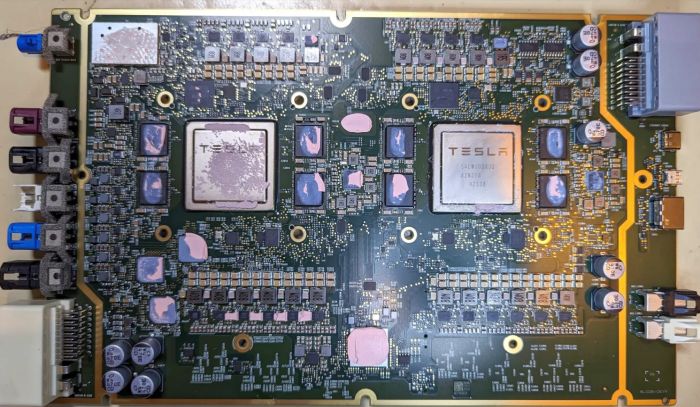
One significant aspect of Hardware 4 is the reintroduction of redundancy. Each board in the new hardware suite has two nodes, which can compute the same data and compare outputs, allowing the vehicle to identify any inconsistencies. This redundancy feature, previously removed in Hardware 3 to maximize processing power, has been reinstated in Hardware 4, ensuring that the vehicle can continue driving safely even if one node fails.
However, it is essential to note that Hardware 4 comes with a higher power draw than its predecessor and has a completely different form factor.
Tesla Hardware 3 vs Hardware 4 Differences
Here’s a quick comparison showing the differences between Tesla AI 3 / HW3 vs AI 4 / HW4. In a nutshell, Hardware 4 has a faster FSD Computer and upgraded sensors, including better cameras and a new, more precise radar.
| AI3 / HW3 (FSD Computer 1) | AI4 / HW4 (FSD Computer 2) |
|---|---|
| Samsung Exynos-IP Based | Samsung Exynos-IP Based |
| 12 CPU Cores | 20 CPU Cores |
| CPU Frequency: 2.2 Ghz | CPU Frequency: 2.35 Ghz |
| 2 Neural Network (NN) Processors | 3 Neural Network (NN) Processors |
| NN Processor Frequency: 2.0 Ghz | NN Processor Frequency: 2.2 Ghz |
| 14 nm Process | Estimated TSMC’s 7nm or N4 (4nm class) |
| 36 TOPS | 50 TOPS |
| 1.2MP cameras around the car | 5MP cameras around the car |
| Radar previously used was Continental’s ARS410 with a range of 160 meters. Discontinued in 2021. | Speculated to be the Arbe Phoenix radar unit with greater detail and a 300 meter range. |
Here you can see the difference between the Hardware 3 and Hardware 4 cameras. The Hardware 4 cameras have much better resolution and color reproduction:
Hardware 4 Rollout
Tesla started delivering new Tesla vehicles equipped with AI4 / HW4 in early 2023, starting with its flagship models, the Model S and Model X. However, some of the features that rely on the new hardware are not yet functional on all models, particularly the Cybertruck.
Exciting news! Model Y are now shipping with Hardware 4! I just went to the delivery lot to see and found a couple. Here are some photos I just got of the cameras on a brand new red Performance Y and AWD Model Y. The lot is filled with new cars awaiting delivery! @elonmusk #Tesla pic.twitter.com/m4Xyga0tN5
— Zack (@BLKMDL3) May 25, 2023
In May 2023, Tesla started producing Tesla Model Y vehicles with Hardware 4.0 (or HW4) out of its Fremont California factory, which began trending on Twitter, noting that Tesla is shipping Model Y with HW4. The Fremont factory is one of Tesla’s main production facilities, where it makes Model 3, Model Y, Model S, and Model X vehicles.
The automaker has almost completely integrated the new hardware throughout its entire lineup.
Current Hardware 4 Implementations
During a dissection of a Model Y Hardware 4 unit, Green (@greentheonly) found the following differences versus Hardware 4 on Model S & X:
- The physical structure of HW4 is similar to the S/X models, debunking any speculation around a potential retrofit to HW3 cars.
- The board layout of HW4 is similar to the HW4 on the Model S, but specific components, including the GPU and superior sound hardware, are now missing or depopulated. This seems to be a cost-cutting measure by Tesla.
- The HW4 uses cheaper non-Error-Correcting Code RAM (ECC RAM) on the infotainment system side. It also features two additional but depopulated display connectors, hinting at a possible second display in the vehicle.
- Other distinguishing attributes of HW4 include a reoriented BroadR-Reach ethernet and the addition of a third, depopulated ethernet. The gateway chip has also changed, with a different model from another vendor now in use.
- Retrofitting HW3 cars with HW4 is not as straightforward as it seems due to the need for modifications to accommodate the new coolant pipe locations. This would likely make retrofitting more costly than simply manufacturing a new board in the old form factor.
- The Texas-manufactured Model Ys feature a plastic “firewall” requiring a change in mounting methods for the new HW4. Despite the internal components remaining the same, the different mounting technique necessitates a unique part number for the computer.
- There’s a reduction in the camera connectors in the Model Y, contributing to the list of differences in the HW4. The missing camera connectors were for additional cameras, such as a front bumper camera. However, the absence of a connector doesn’t mean that Tesla won’t add them in the future.
- While retrofitting HW3 to HW4 may not be feasible due to the cost and complexity involved, Green isn’t entirely ruling out the possibility. He believes a different version could theoretically be created for retrofits, although it’s unlikely.
Hardware 4 on the Cybertruck
The Cybertruck, which entered production in Fall of 2023, debuted with HW4 as well. This means that all of Tesla’s current and all future and new models will have the new hardware that will enable more advanced self-driving capabilities and features. However, the Cybertruck has a notable rollout delay of FSD features versus the Model Y and Model 3, presumably due to the difference in the vehicle architecture and physical dimensions.
How Can I Tell If I Have Hardware 4 (AI4)?
If you’re ordering a new Tesla, check your vehicle’s inventory page. It should list Autopilot as follows:
- Autopilot: AP HW4
You can also tell by looking at the vehicles front-facing cameras on the windshield. There will be two active cameras with a red hue to them and one dummy camera (no longer used in that slot), as shown here:
You can also look at the side cameras on the fenders to see the difference as noted here:
The side camera is the easiest way to tell pic.twitter.com/gRUE4NoIyu
— Jack A (@jjoker0110) May 26, 2023
Upgrading to Hardware 4
Originally, Tesla did not plan to offer retrofits for Hardware 4 for Tesla owners with older autopilot hardware. This is due to the significant changes in the new hardware suite, including additional cameras, new camera placements, a new computer form factor, an HD radar, and a higher power draw. The form factor of HW4 is different and will not fit in a previous model without modifications.
To start with sorta bad news, The form-factor is totally different, so definitely no retrofits on this one.
— green (@greentheonly) February 15, 2023
top/left is new unit, bottom – current plaid unit) pic.twitter.com/iHziGZPIBj
However, during the January 29th 2025 earning’s call, Elon Musk stated that Tesla will provide updates from HW3 (AI3) to HW4 (AI4) to those customers who purchased FSD. He said,
“That’s going to be painful and difficult, but we’ll get it done. Now I’m kinda glad that not that many people bought the FSD package haha.”
So if you purchased FSD on HW3 (vs subscribing), you may be eligible for an upgrade.
The Future
The more advanced features of the Full Self-Driving (FSD) functionality will require ever more capable hardware. In July of 2024 Elon Musk mentioned that new iterations of Full Self-Driving will roll out on Hardware 4 vehicles first and then need be optimized for older Hardware 3 vehicles. As AI driver assistance becomes more sophisticated, the hardware will need to keep pace as well. It will be interesting to see how Tesla manages FSD capabilities across different hardware versions.
We are focusing on just Model Y with HW4 for the initial release. Make sure that works well, then broaden.
— Elon Musk (@elonmusk) July 23, 2024
This has the 5X increase in parameters.
HW3 would run the same parameter count, but requires extra work to optimize the code.
Tesla Hardware 5 (AI5)
In July of 2023, it was reported that Tesla Hardware 5 (HW5) FSD Computer will be manufactured by Samsung Electronics Co., the world’s largest memory chipmaker. These chips will be used in Tesla’s Level-5 autonomous driving vehicles and will be produced on Samsung’s 4-nanometer process. They will be incorporated into Tesla’s Hardware 5 (HW 5.0) computers, which Tesla plans to mass-produce in three to four years.
In summary, with the introduction of Hardware 4, Tesla continues to push the boundaries of self-driving technology. The new hardware suite, despite minor concerns about its processing power, represents a significant step forward for Tesla’s autonomous vehicle capabilities. As Hardware 4 becomes a larger part of the vehicle fleet, it will be fascinating to see how this new technology influences the future of Tesla’s FSD Beta program and the broader self-driving vehicle industry.